Study Links 560 to 610 Minutes of Weekly Exercise to Larger Reductions in Cardiovascular Risk
10/15/2026 / By Zoey Sky

Adults who accumulate between 560 and 610 minutes of moderate-to-vigorous physical activity each week may achieve substantially larger reductions in cardiovascular risk than those who meet the standard 150-minute guideline, according to an observational study published online Aug. 8 in the British Journal of Sports Medicine (BJSM) [1].
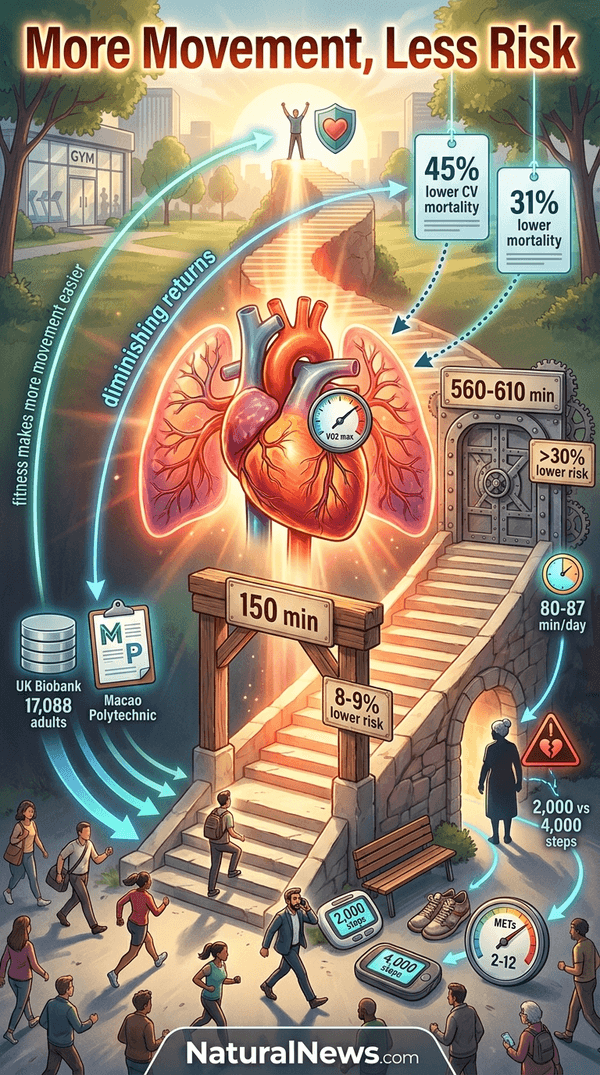
The analysis, conducted by researchers at Macao Polytechnic University, examined data from 17,088 adults in the UK Biobank and followed participants for nearly eight years [1]. Researchers reported that meeting the 150-minute weekly exercise recommendation lowered cardiovascular risk by roughly 8 to 9% [2] [12].
The findings add to a body of evidence suggesting that heart benefits continue to increase as movement increases, and that the relationship between exercise volume and cardiovascular protection may extend well beyond current minimum recommendations [3].
Study Tracked 17,088 Adults Using Wrist Accelerometers and VO2 Max Testing
Cardiorespiratory fitness measures how well the heart, lungs, and muscles work together during movement, and VO2 max, the maximum amount of oxygen the body can use during exercise, is the standard way to assess it, according to a review of research on the topic [4].
The findings were most reliable for people with existing health conditions, according to separate research examining cardiorespiratory fitness as a heart disease predictor [4].
150 Minutes Lowered Risk 8–9%; 560–610 Minutes Tied to Greater Than 30% Reduction
The study found that meeting the standard 150-minute weekly exercise recommendation lowered cardiovascular risk by roughly 8- to 9%, an association that researchers described as modest but meaningful [2] [12].
To achieve a greater than 30% reduction in cardiovascular risk, researchers found participants generally needed between 560 and 610 minutes of moderate-to-vigorous activity each week [1]. That amount of activity is roughly three to four times the commonly cited minimum of 150 minutes per week of moderate-intensity exercise [1] [12].
Separate research has examined the relationship between exercise volume and cardiovascular outcomes. An analysis of the amount of exercise needed to reduce cardiovascular events found that individuals performing exercise at higher volumes experienced a 45% lower risk for cardiovascular disease mortality compared with those who exercised less [5].
Another study found that adults who exercised two to four times the minimum recommended amount might lower their mortality risk by as much as 31% [6].
560 Minutes Breaks Down to About 80 Minutes Per Day, Researchers Said
Walking offers a relatively easy way to accumulate moderate-intensity exercise, and it scores anywhere from 2 to 12 METs depending mainly on speed and terrain, according to New Scientist [7].
Taking the stairs is a practical and often overlooked way to build physical activity into daily life, said study author Vassilios Vassiliou, a professor at the University of East Anglia’s Norwich Medical School [8]. Short bouts of physical activity accumulated throughout the day may carry measurable cardiovascular benefits [9].
For those who find structured exercise difficult, walking has been shown to lower the risk of heart failure in older women, with a study published in JAMA Cardiology revealing that women who walked less than 2,000 steps per day had a higher risk of heart failure compared to those who walked more [10].
A separate study found that walking at least 4,000 steps on just one or two days per week is associated with a significantly lower risk of death and cardiovascular disease in older women [11].
References
- Study: 560 to 610 Minutes of Weekly Exercise Tied to Substantial Heart Risk Reduction. https://www.naturalnews.com/2026-08-14-study-weekly-exercise-tied-heart-risk-reduction.html
- Scientists reveal how much exercise you really need to protect your heart. https://www.sciencedaily.com/releases/2026/08/260806050724.htm
- Epidemiology and Cardiovascular Benefits of Physical …. https://www.ahajournals.org/doi/10.1161/CIRCRESAHA.125.325526
- Researchers Examine Cardiorespiratory Fitness as Heart Disease Predictor. https://www.naturalnews.com/2026-08-18-researchers-examine-cardiorespiratory-fitness-heart-disease-predictor.html
- The Amount of Exercise to Reduce Cardiovascular Events. https://www.jacc.org/doi/10.1016/j.jacc.2015.11.034
- Getting more exercise than guidelines suggest may further …. https://www.heart.org/en/news/2022/07/25/getting-more-exercise-than-guidelines-suggest-may-further-lower-death-risk
- New Scientist The Collection – Issue Three by nextek
- Study Links Stair Climbing to Longevity. https://www.naturalnews.com/2026-09-25-study-stair-climbing-linked-to-longevity.html
- Study Links Regular Stair Climbing to Lower Risk of Cardiovascular Death. https://www.naturalnews.com/2026-09-17-regular-stair-climbing-lower-risk-cardiovascular-death.html
- Study: Walking 2000 steps a day can decrease older women’s risk of heart failure – NaturalNews.com, April 09, 2024.
- A prescription for longevity: New study finds modest achievable walking goals dramatically cut death risk in older… – NaturalNews.com, October 28, 2025.
- This Amount Of Exercise Was Linked To Significantly Lower Heart Risk – https://www.mindbodygreen.com/articles/this-amount-of-exercise-was-linked-to-significantly-lower-heart-risk-comparing-exercise-volume-and-fitness
Explainer Infographic
Submit a correction >>
Tagged Under:
aging secrets, alternative medicine, cardiorespiratory fitness, exercise, fitness, health science, heart disease, heart health, longevity, men's health, natural health, natural medicine, physical activity, prevention, sedentary lifestyle., stroke, VO2 max, VO2 max testing, women's health
This article may contain statements that reflect the opinion of the author
RECENT NEWS & ARTICLES