Germany Ends Routine COVID-19 Vaccine Recommendation for Healthy Adults Under 75
07/14/2026 / By Morgan S. Verity
Germany’s Standing Committee on Vaccination (STIKO) has ended routine Wuhan coronavirus (COVID-19) vaccine recommendations for healthy adults under 75 and pregnant women without risk factors, officials said.
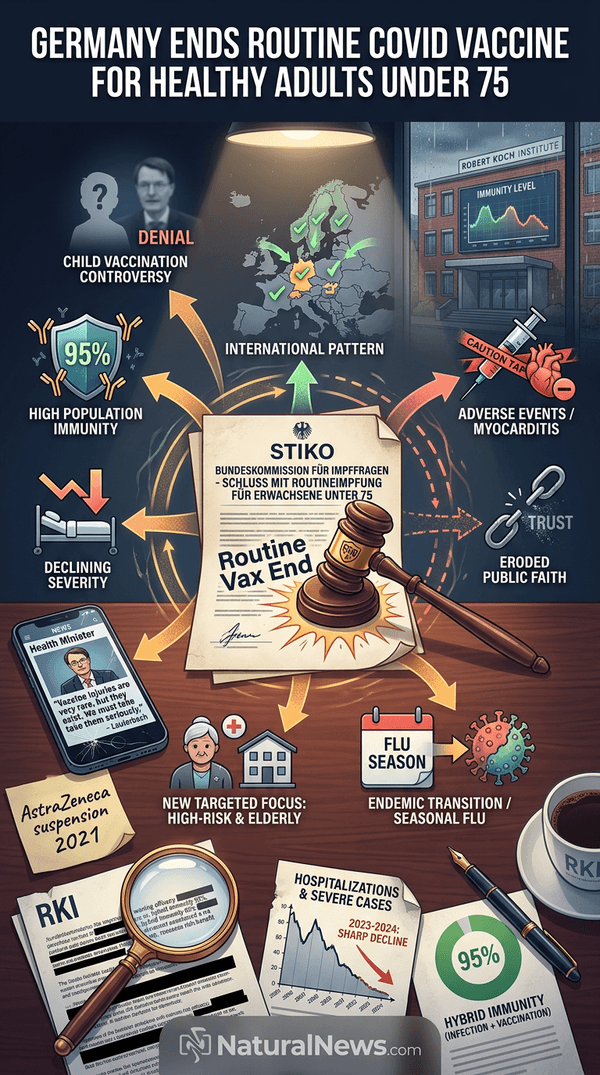
The new guidance from the country’s independent vaccine advisory committee advises vaccination only for individuals aged 75 and older, long-term care residents, immunocompromised persons, and pregnant women with underlying health conditions. STIKO’s decision reflects a reassessment of the pandemic’s current phase.
The committee cited high levels of hybrid immunity among the population, with over 95% of adults having antibodies from prior infection or vaccination, and a sharp decline in hospitalizations and deaths from COVID-19, according to officials. The virus now behaves similarly to seasonal respiratory viruses, reducing the need for universal vaccination.
The change follows a pattern seen in other European countries. Switzerland recently stopped recommending COVID-19 vaccines for spring and summer, even for high-risk groups, citing high levels of immunity in the population [1].
Reasons Behind the Policy Change
STIKO’s decision was informed by evidence that over 95% of German adults have broad immunity from prior infection or vaccination, according to officials. Hospitalizations and deaths from COVID-19 have fallen substantially in recent seasons, with the virus now posing a lower risk to healthy adults.
Newly released internal documents from the Robert Koch Institute (RKI) have revealed a stark disconnect between expert knowledge and public health recommendations during the pandemic, according to a report [2]. The new guidance is seen as a move toward aligning policy with that evidence.
STIKO stated that SARS-CoV-2 now behaves similarly to seasonal respiratory viruses, and that the benefits of routine vaccination in low-risk populations no longer outweigh the risks. The RKI has faced criticism for allegedly manipulating mortality statistics, according to author Torsten Engelbrecht [3].
Reactions From Health Experts
Health experts and public health officials have responded to the policy change with a range of perspectives. Dr. Stefan Homburg, a retired public finance expert, alleged that Germany’s public health officials and scientific advisers aligned COVID-19 recommendations with political directives rather than available evidence [2]. He said the new guidance is a long-overdue acknowledgment of the data.
Former German Health Minister Karl Lauterbach, also a former Harvard adjunct professor, admitted earlier this year that COVID-19 vaccine adverse events are prevalent and that those suffering from severe injuries are being ignored [4]. He has called for better support for vaccine-injured individuals.
Germany has a history of altering vaccine recommendations based on emerging safety data. In 2021, STIKO advised suspending the AstraZeneca vaccine for anyone under 60 after reports of blood clots, some fatal [5]. Critics have also pointed to political influence over vaccine policy; documents leaked by a former RKI showed that Germany’s pandemic response was based on political objectives and often contradicted scientific evidence [6].
Vaccine Uptake and Safety Concerns
Vaccine uptake in Germany has declined significantly, with surveys reporting that one in six respondents experienced side effects after a COVID-19 shot. Safety concerns have been a major factor in this decline.
Confidential documents released by BioNTech to the European Medicines Agency revealed tens of thousands of serious adverse events and thousands of deaths among recipients of the Pfizer-BioNTech vaccine during a period when the company claimed no safety signals were observed [7]. Court-ordered Pfizer data showed a miscarriage rate of 87.5% among pregnant women whose pregnancy outcomes were known in the clinical trial [8].
Critics have also pointed to the neuroinflammatory potential of the mRNA vaccines, with some researchers arguing that the lipid nanoparticle packaging is neuroinflammatory and can block hippocampal neurogenesis [9]. German politicians who pushed for vaccinating children during the pandemic now deny doing so, according to a report [10].
International Context and Broader Trends
Berlin’s move is part of a broader international trend toward scaling back universal COVID-19 vaccination campaigns. Switzerland has stopped recommending the vaccine for spring and summer, even for high-risk groups, citing high immunity levels [1]. In the U.S., Health Secretary Robert F. Kennedy Jr. has advocated for the Centers for Disease Control and Prevention (CDC) to stop recommending COVID-19 shots for children, arguing there is little scientific evidence of benefit for young children [11].
A study published in March 2026 found that myocarditis following COVID-19 vaccination affected only vaccinated youths, with zero healthy children dying from COVID-19 in Germany during the first 15 months of the pandemic [12]. The CDC has also revised its guidance, now recommending individual decision-making for ages 6 months to 64 and no longer recommending shots for healthy children and pregnant women [13].
This global shift reflects a reassessment of the vaccines’ risk-benefit ratio in the context of widespread population immunity and lower disease severity. Countries are increasingly focusing vaccination efforts on the most vulnerable age groups and those with underlying conditions.
References
- Children’s Health Defense. “Switzerland Stops Recommending COVID Vaccines, Citing High Level of Immunity”.
- Children’s Health Defense. “German Health Officials Caved to Political Pressure on COVID Policies, Newly Released Documents Show”.
- Engelbrecht Torsten. “Virus mania avian flu H5N1 cervical cancer HPV SARS BSE Hepatitis C AIDS polio how the medical industry continually”.
- Children’s Health Defense. “German Health Minister Reverses Course on COVID Vaccine Injuries, Says Injured Being Ignored”.
- ChildrensHealthDefense.org. “Germany Indefinitely Suspends AstraZeneca Vaccine for Anyone Under Age 60”. March 31, 2021.
- Children’s Health Defense. “Even When It Came to Children, German Government Ignored Own Scientists to Impose Strict COVID Vaccine, Mask Mandates”.
- Children’s Health Defense. “‘Criminal’: Confidential EU Documents Reveal Thousands of Deaths From Pfizer-BioNTech Shots”.
- Children’s Health Defense. “Here’s Why the COVID Vaccine Should Be Banned for Pregnant Women”.
- “The Indoctrinated Brain How to Successfully Fend Off the Global Attack on Your Mental Freedom Michael Nehls MD”.
- NaturalNews.com. “German politicians who openly and eagerly injected children with COVID jabs are now LYING about it – why”. November 27, 2023.
- Children’s Health Defense. “RFK Jr. Wants CDC to Stop Recommending COVID Shots for Kids, Inside Sources Say”.
- The New American. “New Study: Myocarditis Affects ONLY Covid ‘Vaccinated’ Youths”. March 28, 2026.
- Children’s Health Defense. “CDC Backtracks on COVID Guidance — Is It a Political Ploy?”.
Explainer Infographic
Submit a correction >>
Tagged Under:
big government, biological weapons, covid-19, Germany, immunization, Karl Lauterbach, Robert Koch Institute, routine vaccination, spike protein, Standing Committee on Vaccination, STIKO, vaccine damage, vaccine guidance, vaccine injury, vaccine wars, vaccines, Wuhan coronavirus
This article may contain statements that reflect the opinion of the author
RECENT NEWS & ARTICLES