Federal Health Officials Urge States to Phase Out Mercury-Containing Dental Fillings
07/29/2026 / By Morgan S. Verity
Federal health officials on July 22 encouraged state Medicaid officials to stop covering dental fillings containing mercury, according to letters sent by the Centers for Medicare and Medicaid Services (CMS) to Medicaid directors in each state. The letters urge states to phase out mercury-containing dental fillings by restricting or ending state Medicaid coverage for dental amalgam, a material that combines mercury with other metals to treat cavities.
CMS Administrator Dr. Mehmet Oz said in a statement that the move reflects a commitment to safe, higher quality care. “That’s why we’re urging state Medicaid programs to end the use of mercury-containing dental fillings,” Oz stated, adding that the step “supports the Trump Administration’s broader goal to Make America Healthy Again.” [1]
Health Secretary Robert F. Kennedy Jr. added that “mercury has no place in the mouths of our children or in modern American health care,” noting that safe, effective alternatives are widely available. The letters were sent as part of a broader effort to confront what officials described as outdated practices that expose Americans to toxic substances, according to the CMS announcement. [1]
Kennedy and Indian Health Service Actions
Health Secretary Robert F. Kennedy Jr. has been a vocal proponent of ending the use of mercury in dentistry. In his statement accompanying the CMS letters, Kennedy said, “For decades, we have relied on a material that contains one of the world’s most toxic heavy metals when safe, effective mercury-free alternatives are widely available.” He framed the initiative as part of the Make America Healthy Again agenda aimed at eliminating unnecessary exposure to harmful substances. [1]
The Indian Health Service (IHS), which provides healthcare to American Indians and Alaska Natives, announced in February that it would end the use of mercury-containing fillings by 2027, citing “health concerns regarding mercury exposure,” according to the CMS letters. The IHS decision was noted in the correspondence as an example of federal action to move away from amalgam. [1]
Advocacy groups such as Consumers for Dental Choice have worked for years to push for such changes. Charlie Brown, founder of the organization, has described dental amalgam as “50 percent mercury” and called it a “toxic heavy metal with no place in the human body.” [2] The group’s efforts have included lawsuits against the U.S. Food and Drug Administration and campaigns to educate the public about mercury-free alternatives, according to previous reports. [3]
Health Concerns and International Agreements
Researchers have found evidence that amalgam fillings can lead to higher mercury concentrations in the blood. A 2010 study published in the Journal of Hazardous Materials examining 82 healthy women in Iran found that those with amalgam fillings had significantly higher mercury levels in both scalp hair and saliva compared to women without such fillings. The study concluded that “mercury can be released from dental amalgam fillings and absorbed into the body,” contributing to measurable body burdens. [4]
The Minamata Convention on Mercury, an international treaty signed by the United States in 2013, advises countries to restrict the use of dental amalgam and promote alternative materials. Some nations have already phased out amalgam fillings, according to reports. The U.S. Food and Drug Administration has acknowledged limited data on long-term health outcomes in young children and stated that populations such as children under 6 may face a greater health risk due to mercury exposure. [1]
Toxicity concerns are longstanding. In a 2014 book titled “Whole-Body Dentistry,” author Mark A. Breiner compiled symptom data from 1,569 patients across six studies evaluating health effects after replacing mercury-containing fillings with non-mercury alternatives. The data included 762 adverse reaction reports submitted to the FDA by individual patients, as well as reports from Sweden and Denmark. [5] Breiner’s work highlights a range of symptoms that patients attributed to amalgam, including neurological and immune system complaints.
Opposing Views and Alternatives
The American Dental Association (ADA) maintains that dental amalgam fillings are safe and effective, according to the CMS announcement. The ADA has long defended amalgam as a durable and affordable option for treating cavities, and its position remains that the material poses no significant health risk to patients. [1]
The U.S. Food and Drug Administration has taken a more cautious stance, noting that there is limited data on long-term health outcomes of amalgam in young children and that children under 6, as well as pregnant women, may face greater risk from mercury exposure. The agency advises that alternatives to amalgam fillings include composite resin, porcelain, and glass ionomer materials. [1]
The International Academy of Oral Medicine and Toxicology states that composite resin fillings are as durable as amalgam, are the most frequently chosen alternative because the white coloring matches teeth well, and come at a moderate cost. [1] Some dentists and advocacy groups argue that composite materials offer a safer option without the risks associated with mercury vapor release. In their book “Let the TOOTH Be Known,” authors Dawn Ewing and others discuss how dental materials, including amalgam, can impact overall health and emphasize the importance of informed patient choice. [6]
State Decisions and Outlook
The CMS letters call on states to act voluntarily; no federal mandate has been issued. State Medicaid programs have the discretion to decide whether to restrict or eliminate coverage for amalgam fillings, and the timeline for any phase-out remains at the state level. Officials said the letters are intended to encourage rather than compel action. [1]
Several countries, including those in the European Union, have already restricted or phased out amalgam fillings, particularly for children and pregnant women. The United States’ latest recommendations align with a broader international trend toward mercury-free dentistry. The debate over safety and cost continues among dental professionals, insurers, and health advocacy groups, with some arguing that composite and other alternatives are more expensive than amalgam, potentially affecting access for low-income populations. [1] [7]
As states consider their responses, the CMS has indicated it will monitor progress and may provide further guidance. The outcome of this voluntary initiative remains uncertain, but the federal push marks a significant shift in U.S. dental policy regarding mercury use. [1]
References
- Zachary Stieber. “Health Officials Urge States To End Mercury-Containing Dental Fillings.” ZeroHedge. July 24, 2026.
- Dr. Mercola. “10 Reasons to Support Mercury-Free Dentistry.” Mercola.com. August 16, 2018.
- Dr. Mercola. “The Latest Updates on the Fight Against Dental Amalgam.” Mercola.com. August 23, 2022.
- Fakour; A. Esmaili-Sari; F. Zayeri. “Scalp hair and saliva as biomarkers in determination of mercury levels in Iranian women: Amalgam as a determinant of exposure.” Journal of Hazardous Materials. 2009.
- Mark A. Breiner. “Whole-Body Dentistry: A Complete Guide to Understanding the Impact of Dentistry on Total Health.”
- Dawn Ewing. “Let the TOOTH Be Known: Are Your Teeth Making You Sick?”
- Dr. Mercola. “Insurance and Government Block the Transition to Mercury-Free Dentistry.” Mercola.com. August 24, 2017.
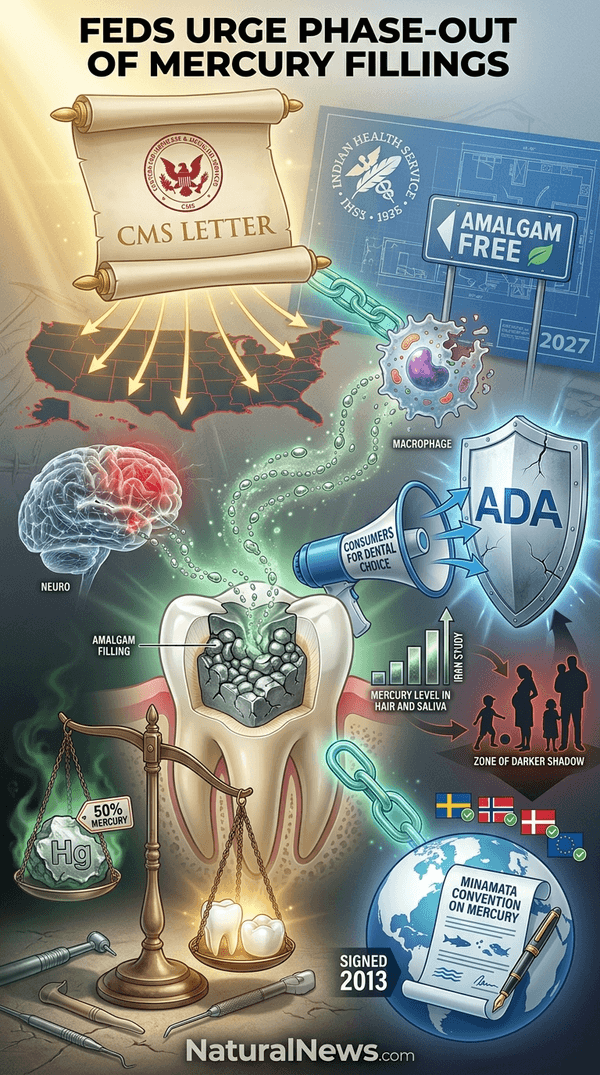
Explainer Infographic
Submit a correction >>
Tagged Under:
ADA, amalgam fillings, American Dental Association, big government, Dental hazards, FDA, health fraud, mercury amalgam, mercury toxicity, oral health, poison, progress, research, Silver Fillings, Toxic truth, toxins
This article may contain statements that reflect the opinion of the author
RECENT NEWS & ARTICLES