
Federal Agencies and Pharmaceutical Companies Built Centralized Pandemic Response Structure, Documents Show
08/21/2026 / By Morgan S. Verity

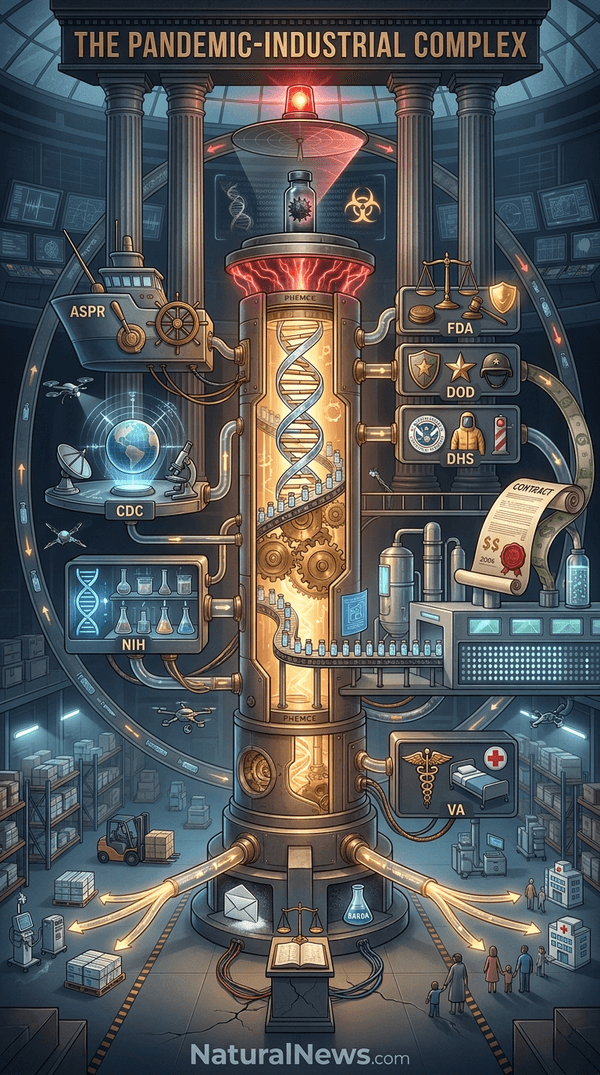
Nearly 14 years before the Wuhan coronavirus (COVID-19) pandemic, the Department of Health and Human Services (HHS) created the Public Health Emergency Medical Countermeasures Enterprise (PHEMCE), centralizing federal health, biomedical, regulatory, homeland-security and military functions around a government-directed countermeasure pipeline, according to reporting by Jon Fleetwood [1][2].
According to Fleetwood, the enterprise centralized seven named federal agencies and components across four Cabinet departments: [2]
- The Assistant Secretary for Preparedness and Response (ASPR);
- The Centers for Disease Control and Prevention (CDC);
- The Food and Drug Administration (FDA);
- The National Institutes of Health (NIH);
- The Department of War (DOW);
- The Department of Homeland Security (DHS) and;
- The Department of Veterans Affairs (VA).
HHS described PHEMCE as a coordinated interagency effort charged with defining and prioritizing countermeasure requirements, coordinating research and development, and setting deployment and use strategies for medical countermeasures held in the Strategic National Stockpile, according to the documents [2]. Fleetwood described the resulting arrangement as the “Pandemic-Industrial Complex” [2].
PHEMCE Structure and Participating Agencies
The April 2007 implementation plan named ASPR as the lead agency, with CDC, FDA and NIH as HHS internal participants, and DOW, DHS and VA as ex officio members, according to the documents [2]. HHS said the enterprise took an end-to-end approach covering research, development, acquisition, storage, maintenance, deployment and guidance for utilization [2].
That structure built on agencies created after the 2001 anthrax attacks. The U.S. government established ASPR and its subdivision, the Biomedical Advanced Research and Development Authority (BARDA), in the wake of those attacks to fortify the nation’s defenses against biological threats, according to a report by Lance D. Johnson [3]. The PHEMCE documents placed those functions inside a single interagency apparatus spanning threat assessment, product development, regulation and deployment [2].
Industry Integration and Incentives
HHS said in the 2006 draft strategy that pharmaceutical manufacturers, biotechnology companies, clinical research organizations and private research organizations had resources and expertise needed to develop medical countermeasures, but had been reluctant to invest because of market uncertainties, according to the documents [2]. The department proposed streamlining the regulatory process, lowering obstacles to private investment and applying liability protections where appropriate, according to the documents [2].
The documents also said government procurement could drive industrial development of medical countermeasures, and that product requirements could cover the entire U.S. population [2]. Fleetwood wrote that private industry was explicitly inserted into that structure [2].
Threat-to-Product Pipeline and Research Alignment
The 2007 implementation plan described a sequence that began with threat detection and intelligence. HHS said medical-countermeasure requirements would incorporate subject matter expert evaluations and domestic and international intelligence information, then move to identify and prioritize near-, mid- and long-term development and acquisition programs, according to the documents [2]. The plan sought technologies for rapid identification and characterization of novel threat agents, followed by rapid production of new vaccines [2].
The plan also called on NIH to align research and development with PHEMCE priority programs and to maintain a sustainable, continuous stream of promising medical countermeasures aligned with future acquisitions, according to the documents [2]. Fleetwood wrote that the architecture runs from threat designation to intelligence, product requirement, research, industrial development, acquisition and deployment [2].
Conflict in the Pandemic-Industrial Complex
One section of the 2006 draft strategy contains a national-security warning. HHS said laboratory-engineered organisms “might even be mistaken as naturally occurring emerging agents,” and the article noted that Congress, the White House, the Department of Energy, the Federal Bureau of Investigation, the Central Intelligence Agency and Germany’s Federal Intelligence Service all acknowledged that COVID-19 was “likely” the result of a laboratory incident involving engineered pathogens [1].
By 2016, the PHEMCE structure was already overseeing a large stockpiling effort. Since 1999, the federal government has collected, prepared and stored massive amounts of medical and emergency supplies, with an agency called the Public Health Emergency Countermeasures Enterprise coordinating with multiple federal agencies, according to an article published by NaturalNews.com [4]. The concentration of functions – defining threats, financing research, setting product requirements, buying products and organizing deployment – raises questions about oversight, according to the documents [2].
Conclusion: A System With Unanswered Questions
Fleetwood asked: “Who independently investigates the system when the system itself may be implicated?” [1]. The question follows from the documents’ own description of an apparatus that can help define a threat, fund research around it, integrate private industry, determine product requirements, influence regulation, create a market through procurement and organize deployment [2].
The dual-use character of scientific research has been noted before. Margalit Fox wrote that the war brought “the duality of the age into sharp relief: the wonders of science and technology… seemed far less wondrous in the twentieth when realized as air warfare and nerve gas” [5].
References
- Jon Fleetwood. “7 Federal Agencies & Big Pharma Quietly Built A Pandemic-Industrial Complex”. ZeroHedge. August 19, 2026.
- Jon Fleetwood. “7 Federal Agencies + Big Pharma Quietly Built A Pandemic-Industrial Complex”. Modernity.news. August 18, 2026.
- Lance D Johnson. “US biodefense industry is a house of flimsy cards falling in real time”. NaturalNews.com. February 11, 2025.
- NaturalNews.com. “What do they know that we don’t? While the CDC invests in mass bunkers, 67 different federal agencies stockpile weapons of war.” July 5, 2016.
- Margalit Fox. “Conan Doyle for the Defense”.
Explainer Infographic
Submit a correction >>
Tagged Under:
big government, Big Pharma, Centers for Disease Control and Prevention, Department of Health and Human Services, Department of Homeland Security, Department of Veterans Affairs, Department of War, Food and Drug Administration, Jon Fleetwood, National Institutes of Health, national security, outbreak, pandemic, pandemic response, Plague, real investigations
This article may contain statements that reflect the opinion of the author