Review Links Two Slices of Deli Meat Daily to 44% Higher Dementia Risk
10/01/2026 / By Coco Somers

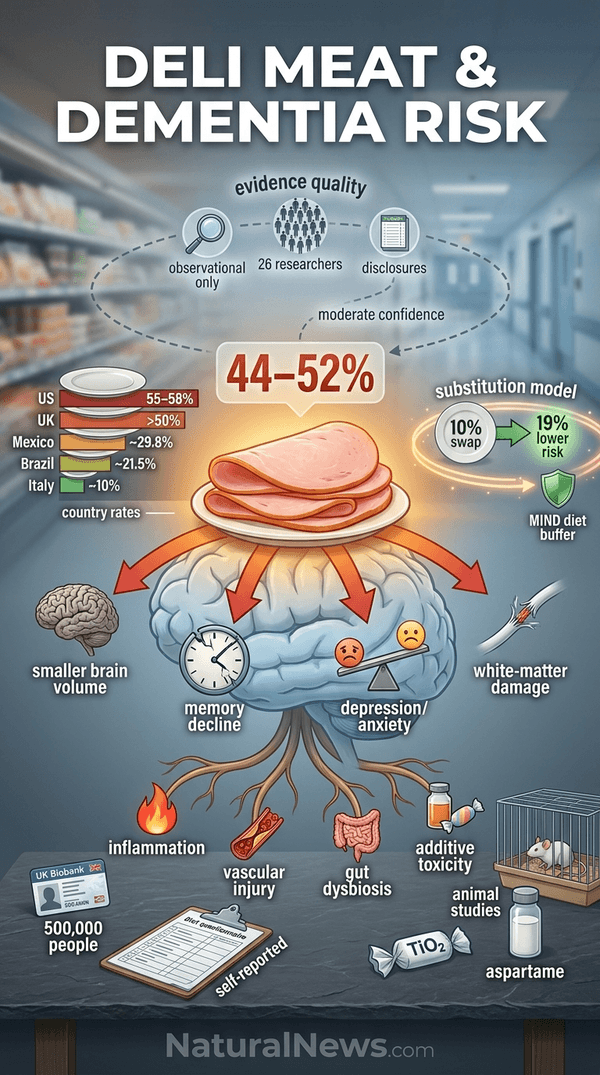
Each additional 25 grams of processed meat consumed daily — roughly the weight of two slices of deli turkey — corresponded with a 44% to 52% increase in the risk of all-cause dementia and Alzheimer’s disease, according to a scientific review published in Annual Review of Nutrition. The review, authored by 26 researchers from institutions worldwide, synthesizes decades of research on ultra-processed foods and brain aging.
The underlying human data came largely from a UK study of nearly 500,000 people, according to the review. Lead author Owen T. Carmichael is based at the Pennington Biomedical Research Center in Baton Rouge, Louisiana. The authors state plainly that all human evidence on the topic is observational, meaning it can show associations but cannot prove that processed meat causes dementia.
Separate modeling of UK Biobank data estimated that replacing 10% of daily calories from ultra-processed foods with unprocessed food could lower dementia risk by 19%, the review stated. The findings add to a growing body of evidence linking highly processed foods to cognitive decline, with processed meat showing the strongest association, according to reporting on related research [1].
Key Findings: Ultra-processed Foods, Modeling, and Brain Health
The review documents effects that extend beyond dementia. A study in Brazil following more than 10,000 adults for about eight years found that people who got more than roughly 20% of their daily calories from ultra-processed foods experienced faster declines in memory and reasoning, though the effect appeared only among participants who did not closely follow the MIND diet, a brain-healthy eating pattern emphasizing whole foods, according to the review.
Mental health outcomes showed a similar pattern. Pooled data across multiple large reviews found that people with higher ultra-processed food intake had roughly 22% to 53% higher odds of depression or anxiety symptoms, depending on the outcome and dataset examined, the review stated.
Brain imaging research cited in the review linked higher intake of fat, sugary sodas, meat and processed meat products to smaller brain volume. Sugary sodas and certain fats were tied to more damage in the brain’s white matter, the tissue that helps different regions of the brain communicate, according to the review. Independent neuroscientists have issued similar warnings, noting that common dietary choices, including alcohol, processed meats and artificial sweeteners, can contribute to inflammation and oxidative stress [2]. Research on ultra-processed food also has been linked to reduced attention span and higher scores on measures of modifiable dementia risk factors [3]. Medical professionals who study longevity conditions list dementia alongside heart disease, stroke, cancer, depression and anxiety as leading chronic conditions, noting that lifestyle factors play a significant role [4].
Defining Ultra-processed Foods and Consumption Patterns
Ultra-processed foods are not simply foods touched by a factory. According to the review, they stand apart because two things happen at once: natural ingredients like fiber and plant compounds get stripped out, while sugar, fat, salt and lab-made additives such as sweeteners, colorings and thickeners get added in. Sodas, packaged snack cakes, frozen ready meals and many processed meats fit the definition.
Other analyses of the food supply describe ultra-processed products as having few, if any, whole ingredients [5]. Processed meats in particular have been identified among five key food groups that disrupt gut health by driving dysbiosis, an imbalance in gut bacteria linked to increased gut permeability and systemic inflammation [6].
Consumption varies sharply by country. In the United States, ultra-processed foods make up somewhere between 55% and 58% of daily calories, among the highest rates in the world, according to the review. The United Kingdom similarly exceeds 50%. Brazil sits at about 21.5%, Mexico at roughly 29.8%, and Italy had the lowest rate among countries studied at about 10%. Consumption has been climbing worldwide, the review stated.
Mechanisms, Evidence Gaps, and Limitations
Proposed mechanisms linking ultra-processed foods to brain harm include inflammation, damage to blood vessels and disruption of the chemical signals brain cells use to communicate, though the review’s authors describe the biology as poorly understood. Animal research offered clues that human studies cannot easily test. Mice bred to develop Alzheimer’s-like disease and fed high-fat diets with added sugar or salt built up more of the toxic proteins linked to Alzheimer’s in the brain’s memory center, according to the review.
Other lab studies pointed to specific additives. Mice given aspartame over long periods showed brain changes associated with Parkinson’s disease, while titanium dioxide, a whitening agent used in some processed foods, impaired memory and learning in animal studies and killed brain cells grown in the lab, the review stated.
The evidence has limits. All human evidence is observational. Most mechanistic findings come from animal studies. Human studies often rely on self-reported food questionnaires not specifically designed to measure ultra-processed food intake, and there is no universal classification system for which foods count as ultra-processed. Randomized controlled trials, the gold standard for proving cause and effect, are largely missing, and confidence in the best available evidence was rated moderate in the review’s own tally.
A Case for Caution, Not Panic
Trials proving cause and effect are still missing, and the review’s authors say so plainly. Even so, diets heavy in ultra-processed foods keep showing up alongside worse outcomes for memory, mood and brain structure across multiple countries and multiple types of studies, according to the review. The same pattern has been documented in other analyses: deep-fried and sugary foods have been cited for their neurotoxic potential, and study after study has linked ultra-processed food intake to accelerated cognitive decline [7]. Studies published across peer-reviewed literature have linked high ultra-processed food consumption to depression, reduced attention and altered brain signaling [8].
References
- NaturalNews.com. “Study Links Ultraprocessed Foods to Cognitive Decline; Processed Meat Shows Strongest Association”. NaturalNews.com. June 21, 2026.
- NaturalNews.com. “The worst foods for your brain: Neuroscientists reveal what to avoid for optimal cognitive health”. NaturalNews.com. August 13, 2026.
- Everyday Health. “Ultra-Processed Food Could Be Hurting Your Attention Span”. Everyday Health. April 27, 2026.
- Aseem Malhotra. “The 21-Day Immunity Plan”.
- Mercola.com. “60% of Calories Are From Ultraprocessed Food”. Mercola.com. June 28, 2023.
- NaturalNews.com. “Your Gut’s Worst Enemies: The 5 Foods That Sabotage Your Inner Ecosystem”. NaturalNews.com. April 13, 2026.
- ANH International. “News in Brief Week 50 2022”. ANHinternational.org. December 15, 2022.
- Patrick Lewis. “Could Your Weekly Grocery Shop Influence Your Risk of Dementia? The Diet That May Delay Brain Aging”. NaturalNews.com. April 24, 2026.
Explainer Infographic
Submit a correction >>
Tagged Under:
Alzheimer's disease, brain function, brain health, Censored Science, chemicals, cognition, cognitive decline, Dangerous, dementia, food science, health science, Mind, poison, processed meat, research, stop eating poison, toxic foods, toxic ingredients
This article may contain statements that reflect the opinion of the author
RECENT NEWS & ARTICLES