Trial Finds Lion’s Mane and Reishi Blend Reduced Anxiety Scores More Than Lion’s Mane Alone
11/04/2026 / By Coco Somers
A four-week, randomized, double-blind, placebo-controlled trial published in October 2026 in the journal Frontiers in Nutrition reported that a blend of lion’s mane and reishi mushrooms reduced anxiety scores more than lion’s mane alone in 84 young women, according to researchers at Northumbria University in the United Kingdom.
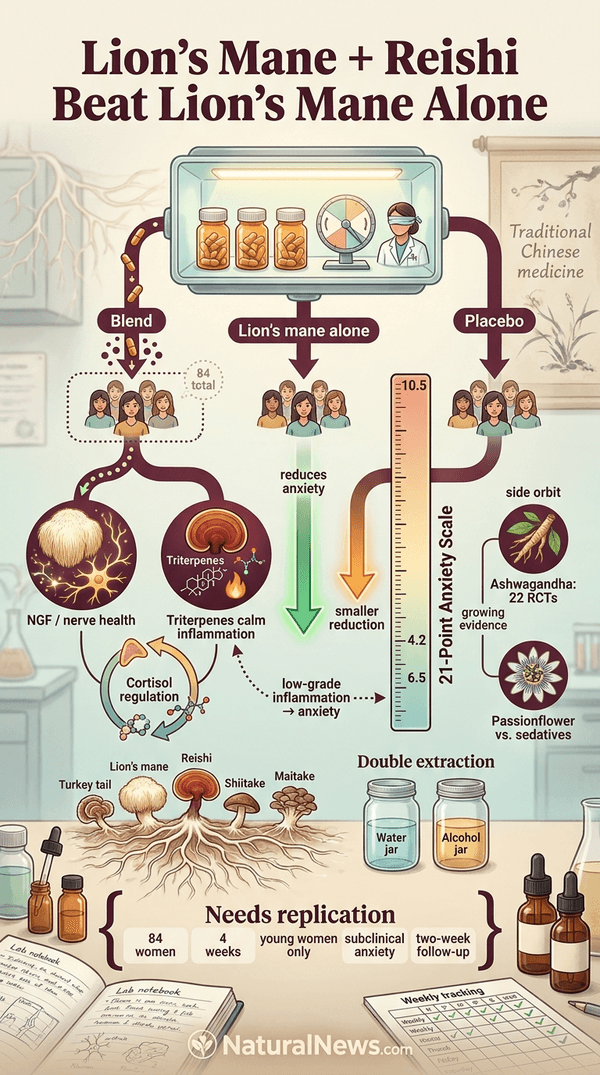
Participants were randomly assigned to one of three groups: lion’s mane alone, a blend of lion’s mane and reishi, or a look-alike placebo. Anxiety was measured on a standard 21-point scale. The study’s authors stated that the findings require confirmation in larger and more diverse trials.
Study Design and Methods
Each participant reported everyday stress or anxiety but had no diagnosed mental health condition. The researchers randomly assigned the women to one of three groups for four weeks: one group took lion’s mane alone, a second took a blend of lion’s mane and reishi, and a third took a look-alike placebo.
The research team tracked anxiety and stress levels every week during the four-week supplementation period and again two weeks after the capsules ran out. Anxiety was measured using a standard 21-point anxiety scale, according to the researchers.
Mushrooms have a long and well-documented history in alternative medicine, with the Chinese among the first to recognize their therapeutic potential, according to published accounts [1]. All medicinal mushrooms share adaptogenic properties that primarily involve regulating cortisol levels, the same accounts state, and more people are recognizing mushrooms’ use in maintaining health during times of stress.
Five specific fungi – turkey tail, lion’s mane, reishi, shiitake and maitake – are identified by both traditional medicine systems and modern research as sources of compounds that may support human health, according to a separate report [2].
Results at Day 28
On the 21-point anxiety scale, the blend group averaged about 4.2, while the lion’s mane group averaged 6.5. For reference, both groups started the study at roughly 10.5. The blend contained less lion’s mane than the single-mushroom capsules, suggesting reishi added a different kind of benefit, according to the researchers.
A published commentary on the trial explained the comparison without endorsing the supplement. “Reishi contains compounds called triterpenes, which laboratory research suggests help calm inflammation,” the report stated.
The finding aligns with a broader body of research on natural approaches to stress and mood. A 2026 scientific review that pooled data from 22 randomized controlled trials involving 1,391 adults found that ashwagandha significantly reduced symptoms of stress, anxiety, and depression compared with a placebo, according to a report on the findings [3]. Separate coverage of a December 2025 clinical trial published in Scientific Reports stated that passionflower matched the prescription sedatives it was tested against, according to the report [4].
Possible Mechanism and Limitations
The researchers proposed that reishi may add an anti-inflammatory effect on top of what lion’s mane provides, according to the study report [5]. Reishi contains compounds called triterpenes, which laboratory research suggests help calm inflammation. A growing body of research links low-grade inflammation in the body to feelings of anxiety, the report stated.
Reference texts on natural medicine list reishi and lion’s mane among mushrooms with anti-inflammatory activity, alongside chaga, shiitake, enokitake, maitake and other species [6]. The same reference describes triterpenes as one of the compound classes associated with antiallergic activity in Ganoderma species, the genus that includes reishi [6]. Herbal references describe reishi as an adaptogenic herb, with practitioners preferring double-extracted tinctures that make available both the water-soluble and alcohol-soluble components of the mushroom [7].
The sample was small, at 84 women. The supplementation period lasted only four weeks. Participants were young women without diagnosed mental health conditions, which limits how broadly the results can be generalized. The authors stated that the results require confirmation in larger and more diverse trials.
References
- How medicinal mushrooms keep you strong even if you’re constantly stressed – NaturalNews.com, December 16, 2018.
- Go Beyond The Superfood Trend These 5 Mushrooms Are Real Medicinal Powerhouses – NaturalNews.com, March 12, 2026.
- Nature’s answer to stress? New science says this ancient root delivers. https://www.naturalnews.com/2026-08-17-nature-stress-science-ancient-root.html
- Natural calm: How passionflower matches sedatives in new clinical trial. https://www.naturalnews.com/2026-07-14-passionflower-matches-sedatives-in-new-clinical-trial.html
- Calm anxiety with the “perfect pair” of traditional remedies, new trial. https://beforeitsnews.com/health/2026/10/calm-anxiety-with-the-perfect-pair-of-traditional-remedies-new-trial-reveals-3072039.html
- Textbook of Natural Medicine Fifth Edition. Dr Michael T Murray
- The Lost Book of herbal Remedies. Nicole Apelian & Claude Davis
Explainer Infographic
Submit a correction >>
Tagged Under:
adaptogens, anxiety relief, food cures, food is medicine, food science, functional food, health science, lion's mane, mental health, Mind, mind body science, Mushrooms, natural cures, natural health, reishi, remedies, research, stress relief
This article may contain statements that reflect the opinion of the author
RECENT NEWS & ARTICLES