Study: Daytime Light Exposure Linked to Lower Dementia Risk
06/29/2026 / By Coco Somers

A large study published Thursday, June 25, in the journal General Psychiatry has found that spending time in bright daytime light is associated with a reduced risk of developing dementia.
Researchers from universities in China followed nearly 87,600 adults for eight years, using wrist devices that measured light exposure and physical activity. During the study period, 741 participants developed dementia.
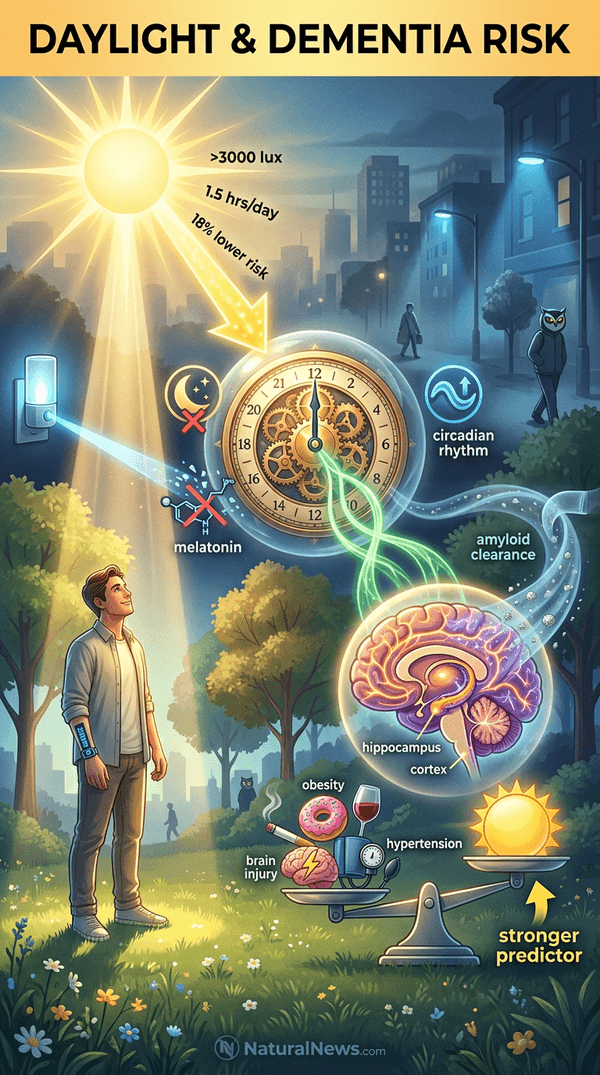
According to the findings, spending at least 1.5 hours per day in light of 3,000 lux or higher – equivalent to outdoor brightness – was linked to an 18% lower risk of dementia compared with those who spent less time in such conditions. Average daytime light exposure above 1,000 lux, described as moderately bright indoor light or an overcast day outdoors, was associated with a 16% reduced risk. [1] Erik S. Musiek, MD, PhD, a professor of neurology at Washington University, said in an interview that “outdoor light is very bright and can help strengthen circadian rhythms, which we think is a good thing.”
Details of the Research and Key Findings
The study participants had an average age of 62 and wore actigraphy devices that combined light sensors with accelerometers. The researchers tracked light exposure levels over the eight-year follow-up. They found that 40 to 45 minutes per day in very bright light of 7,000 lux or higher corresponded to a 17% lower dementia risk.
The analysis also showed that less than 0.7 hours of bright daytime light per day was a stronger predictor of dementia than six established risk factors, including obesity, alcohol consumption and traumatic brain injury. Even among participants who were exposed to light at night – which can disrupt sleep – getting sufficient bright light during the day was still linked to a 30% to 38% lower risk. [2] A prior December study published in Neurology had found that people with irregular sleep-wake patterns faced up to a 50% higher dementia risk, highlighting the importance of circadian stability.
Mechanisms and Broader Implications
The study authors wrote that light exposure serves as a primary cue for the circadian system, the body’s internal 24-hour clock, which regulates cognition. Disruptions to circadian rhythms are a recognized risk factor for neurodegenerative conditions including dementia. [3] According to Russell Foster and Leon Kreitzman in “Circadian Rhythms: A Very Short Introduction,” the 24-hour light-dark cycle is the most important environmental time cue for synchronizing biological rhythms.
The researchers noted that brain scans have shown dementia is linked to shrinkage in key brain regions, and early research suggests adequate daylight may help slow that shrinkage. [4] A previous article on NaturalNews.com noted that emerging research suggests sunlight offers benefits beyond vitamin D, including effects on nitric oxide and serotonin that may support brain health. [5]
Lynne Peeples wrote in “The Inner Clock” that as people age, cataracts and yellowing lenses can limit the amount of blue light reaching photoreceptors, potentially weakening circadian responses. The protective effect of daytime light persisted even for people with genetic mutations linked to Alzheimer’s disease – who saw a 19% to 27% lower risk – and for self-described night owls, who saw a 40% lower risk when they obtained more daytime light.
Public Health Implications and Expert Comments
The study authors stated in their paper: “These findings position daytime light exposure as a novel, robust and measurable indicator of dementia risk.” They added that “further research should explore its role in dementia screening and inform the development of light-based interventions.” [6] A 2008 study published in JAMA and cited by NaturalNews.com found that daytime bright lighting was associated with modest improvement in dementia symptoms, suggesting that light exposure may have therapeutic value.
Currently, about 7 million Americans live with dementia, and that number is expected to nearly double by 2050, according to the study. The researchers called for public health guidelines recommending increased daytime light exposure as a low-cost strategy to support brain health, particularly in high-risk populations. With evidence mounting that circadian disruptions predict dementia, the authors said simple behavioral changes – such as spending more time outdoors – could have meaningful impacts.
Conclusion
The study adds to a growing body of evidence linking environmental light exposure to cognitive health. While the researchers emphasized that the observational nature of the study does not prove causation, they said the results provide a strong rationale for future research into light-based interventions. The findings highlight a potentially modifiable risk factor that is accessible to nearly everyone.
References
- “Could Sunshine Help Protect Against Dementia?” EverydayHealth.com. June 25, 2026.
- “Your Body Clocks Could Predict Dementia Decades Later.” ZeroHedge.com. February 11, 2026.
- Russell Foster and Leon Kreitzman. “Circadian Rhythms: A Very Short Introduction.”
- NaturalNews.com. “How a Few Minutes of Sunlight Can Transform Your Health and Well-being”. NaturalNews.com. November 20, 2025.
- Lynne Peeples. “The Inner Clock: Living in Sync with Our Circadian Rhythms.”
- NaturalNews.com. “Use of Bright Lighting May Improve Dementia Symptoms”. NaturalNews.com. August 13, 2008.
Explainer Infographic
Submit a correction >>
Tagged Under:
Brain, brain function, brain health, Censored Science, circadian rhythm, Cures, dementia, healing, health science, mental, Mind, mind body science, natural health, natural light, outdoor light, prevention, remedies, research, sunlight, sunlight exposure, sunshine vitamin, vitamin D
This article may contain statements that reflect the opinion of the author
RECENT NEWS & ARTICLES