HHS: States Can Order COVID-19 Vaccines for Low-Income Children Through CDC Program
10/02/2026 / By Morgan S. Verity

Wuhan coronavirus (COVID-19) vaccines are available for states to order through the Centers for Disease Control and Prevention‘s (CDC) Vaccines for Children (VFC) Program.
Grace Davis Jamison, press secretary at the Department of Health and Human Services (HHS), confirmed this information in a statement provided to The Defender. The Washington Post reported last week that the ordering process had opened after being in limbo for nearly a month.
The VFC Program provides vaccines at no cost to low-income children age 18 or younger, including those enrolled in or eligible for Medicaid, according to federal program descriptions. The shift means states can now request doses for a population that has seen steeply declining uptake in recent seasons.
Background: VFC Program and Pfizer Contracts
About half of U.S. children receive their vaccinations through the VFC, according to a 2024 CDC statement cited in coverage. The program has long functioned as the federal government’s primary conduit for pediatric immunization among lower-income families.
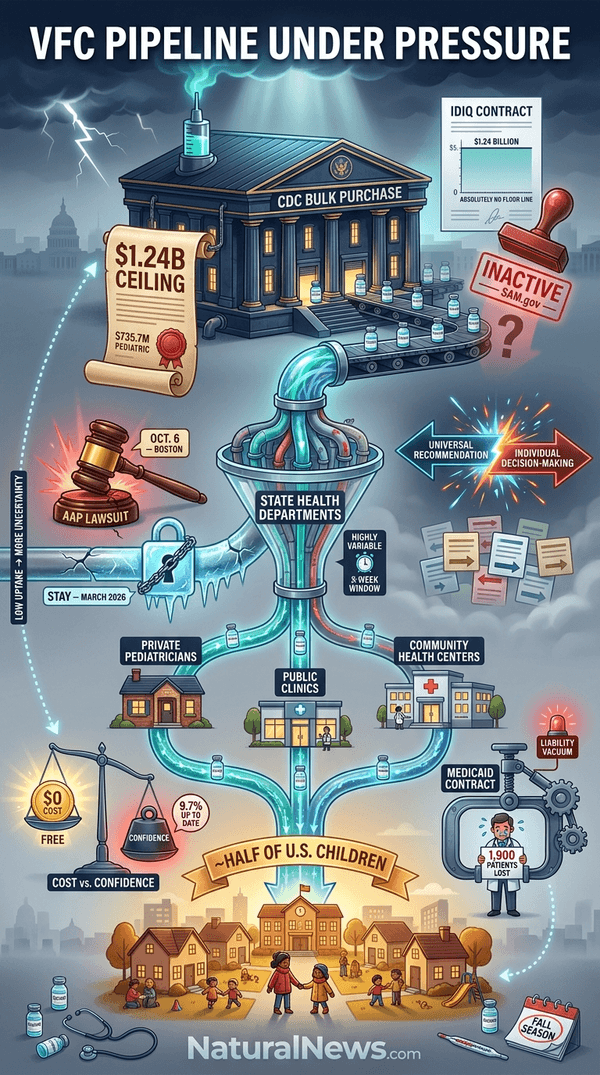
The CDC finalized two Pfizer COVID-19 vaccine contracts in June valued at more than $1.24 billion for fiscal years 2026 and 2027, including $735.7 million for pediatric vaccines, according to reporting. Health Secretary Robert F. Kennedy Jr. said the claim that the CDC had already spent $1.24 billion was simply wrong, describing the agreements as Indefinite Delivery/Indefinite Quantity contracts, which allow orders to be placed as needed rather than obligating funds upfront.
Both contracts remain listed as inactive on SAM.gov, the federal procurement database, as of writing. The discrepancy between the announced awards and the inactive status has not been fully explained by agency officials.
Policy Changes and Pending Litigation
In May 2025, Kennedy announced the CDC would no longer recommend COVID-19 vaccines for healthy children six months and older and healthy pregnant women. The changes became official in September 2025 after a vote by the Advisory Committee on Immunization Practices recommending individual-based decision-making.
The American Academy of Pediatrics and other medical organizations sued HHS, Kennedy and federal health agencies. A March 2026 court-ordered stay froze the recommendations, and an appeal is pending with oral arguments scheduled for Oct. 6 in Boston. The CDC quietly reinstated its July 2025 recommendations earlier this month, including off-label use for immunocompromised infants and children, according to Maryanne Demasi, Ph.D [1].
Jamison said HHS policy remains shared clinical decision-making and that vaccines are only indicated for children with at least one underlying condition. Pediatrician Dr. Michelle Perro said HHS and CDC appear to be hedging as they navigate conflicting policies and court rulings, placing responsibility on clinicians and parents [2].
Access Concerns and State Variability
The Wall Street Journal reported that state health departments typically order COVID-19 shots within two weeks of commercial availability. The delay could prevent millions of children from getting shots during the early fall season, the report stated.
The AAP said VFC availability will remain highly variable across states, depending in part on how long states take to implement ordering systems, whether initial supplies are limited and how quickly states distribute vaccines. Variation in state-level implementation has been a recurring feature of immunization programs [3].
Dr. Michelle Fiscus told the Tennessee Outlook it is not unusual for the program to procure vaccines later than commercial availability, but what is happening this year is unusual. Brian Haile meanwhile said: “There are concerns we’re going to have much lower COVID vaccination rates than we could otherwise achieve.”
VFC Coercion Claims and Vaccination Rates
Some pediatricians and advocates view the VFC Program as coercive because participating physicians must administer the vaccines to Medicaid and other low-income patients or risk losing their Medicaid contracts. A California pediatrician is suing the CDC over the program, alleging it violates the Fifth Amendment by subjecting children enrolled in Medicaid to different treatment standards and compelling doctors to act against their professional judgment [4].
Dr. Samara Cardenas lost her Medicaid contract and 1,900 patients after declining to give COVID-19 vaccines, saying safety concerns drove her decision [5]. Dr. Paul Thomas said some VFC families were there specifically because they did their research and didn’t want vaccines or wanted to go slowly [6].
CDC data show fewer than one in 10 children ages six months to 17 years, or 9.7%, were up to date on COVID-19 shots by May 2026 [7], and 3% of parents planned to vaccinate their kids. Children in households earning $75,000 or more had a higher vaccination rate than those below poverty. In Canada, more than 80% of parents skipped COVID-19 vaccines for their children, with about 25% citing safety concerns [8].
Conclusion: Program Rollout Leaves Parents With Decisions
The reopening of VFC ordering puts COVID-19 vaccines back within reach for millions of low-income children, but the operational reality remains unsettled. Pending litigation, inactive contracts and state-by-state ordering timelines leave the program’s near-term footprint uncertain.
Kennedy has said HHS policy centers on shared clinical decision-making, while critics contend the VFC framework leaves physicians and parents with little room to decline. Either way, the practical result is that the burden of decision-making is shifting toward families and clinicians while federal guidance remains contested.
References
- “In Shadow of Pending Lawsuit, CDC Again Recommends COVID Vaccines for Infants and Young Kids”. ChildrensHealthDefense.org. September 26, 2026.
- S.D. Wells. “CDC Still Highly Recommends Deadly COVID JABS for ‘Moderately Immunocompromised’ Children Who Are More Likely to Die from mRNA Prions”. NaturalNews.com. June 02, 2025.
- “Will more inputs improve the delivery of health services?: Analysis of district vaccination coverage in Pakistan”. Journal of Health Economics.
- “CHD Funds Lawsuit Against CDC Over Program That Forces Pediatricians to Give COVID Vaccines to Kids on Medicaid”. ChildrensHealthDefense.org.
- “‘I Will Not Do Harm’: Pediatrician Suing CDC Explains Decision Not to Give COVID Vaccines to Kids”. ChildrensHealthDefense.org.
- Brenda Baletti, Ph.D. “Doctors in Kentucky California Received Millions in Bonus Payments for Vaccinating Medicaid Patients Against COVID-19”. ChildrensHealthDefense.org. January 21, 2024.
- “CDC Recommends COVID-19 Vaccine to All Adults, Many Children”. NTD.com. September 25, 2026.
- “Over 80% of Canadian Parents Skip COVID Vaccine for Their Kids: Report”. TheEpochTimes.com. August 11, 2026.
Explainer Infographic
Submit a correction >>
Tagged Under:
big government, Big Pharma, CDC, covid-19, HHS, immunization, low-income children, pandemic, pharmaceutical fraud, Plague, Robert F. Kennedy Jr., vaccine wars, vaccines, Wuhan coronavirus
This article may contain statements that reflect the opinion of the author
RECENT NEWS & ARTICLES